From Ph.D. to Lead Data Engineer
AI Guild Competency Profile No 23210678

In the European data economy, few roles exemplify the combination of scientific rigor and practical impact as clearly as the Lead Data Engineer with a PhD in Computer Science. This expert acts as a bridge between advanced research, applied engineering, and scalable product delivery.
He is trained in algorithmic thinking and systems design at a top German technical university, and combines intellectual depth with a practical approach to data architecture.
He is a Lead Data Engineer
His career path shows how a highly skilled data and AI professional can advance from academic research to consulting leadership, and ultimately to platform ownership in industry. It is a journey marked by mastery through practice—learning to deliver at scale, building teams, and translating complex requirements into dependable systems that produce measurable business value.
Career path
After earning his PhD in Computer Science, he entered the industry through a global consulting firm — a familiar yet demanding path for postdoctoral talent in Europe. Consulting offered a unique environment for accelerated learning: exposure to multiple domains, quick iteration across projects, and direct engagement with clients who expect both technical excellence and business results.
Over 5 years in consulting, he progressed from an individual contributor to a technical lead. His work focused on data engineering in telecom and infrastructure analytics — designing and maintaining large-scale ETL and ELT workflows, optimizing data lakes, and delivering KPIs for enterprise dashboards. This period laid the foundation for his work in production-grade data systems, developing both technical confidence and the ability to lead small engineering teams.
The next step, transitioning into an internal product organization, marked the shift from delivery to ownership. Here, he began designing end-to-end data and machine learning pipelines within a cloud-native SaaS environment. His focus shifted from project execution to platform scalability, automation, and continuous integration. He started establishing standards — for code quality, documentation, GDPR compliance — and coordinating efforts across data, ML, and business teams.
This progression reflects a broader trend among PhD-trained data professionals: moving from analytical specialization toward platform leadership. By leveraging his academic background and consulting experience, he developed into a Lead Data Engineer — responsible not only for technical delivery but also for ensuring that data systems support long-term business growth.
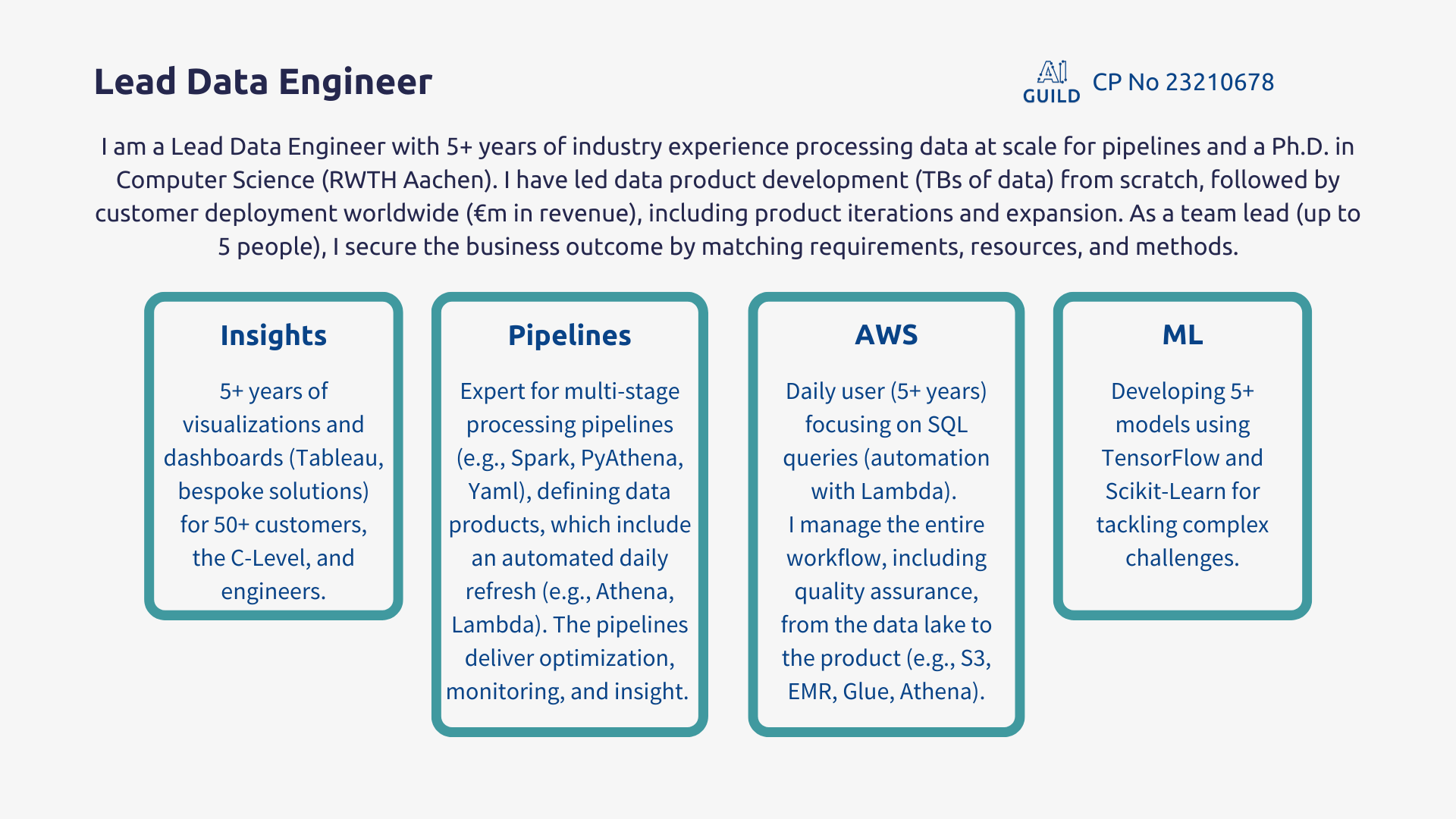
Ready to lead data engineering
Leadership in data engineering centers on ownership, influence, and mentoring. Throughout his career, he has cultivated all three aspects.
As a technical lead, he has steered teams of engineers through architectural choices, code reviews, and performance improvements. By establishing engineering standards and providing practical support, he enables junior colleagues to learn through hands-on experience.
As a team lead, he facilitates cross-functional collaboration among data engineers, data scientists, and analysts. He aligns technical priorities with business objectives, ensuring that infrastructure investments lead to tangible results.
His impact includes organizational mentorship — enhancing data literacy among product managers, helping non-technical stakeholders understand results, and engaging in data strategy discussions at the company level.
This blend of technical guidance and strategic communication exemplifies the maturity of a Lead Data Engineer.
Breadth of competence
The range of his technical and organizational skills reflects the interdisciplinary nature of data engineering today.
On the technical side, he combines solid software engineering fundamentals (Python, SQL, Docker, Terraform) with extensive familiarity across the modern data stack: Spark and PyAthena for distributed processing, Airflow and MWAA for orchestration, dbt for transformation logic, and AWS Glue and Redshift for data warehousing. He has designed infrastructure for both batch and streaming pipelines, incorporating CI/CD workflows to ensure reliability and scalability.
His cloud expertise is comprehensive, especially within the AWS environment — S3, EMR, Glue, Lambda, Redshift, SageMaker — where he has built data lakes, managed model deployments, and automated end-to-end workflows.
In terms of domain experience, he has delivered production systems across telecommunications, healthcare, and sports. The variety of these sectors enhanced his understanding of compliance (notably GDPR), security, and data governance — vital skills for senior engineers working in regulated European contexts.
Years of client-facing experience have improved his ability to communicate with stakeholders, gather requirements, and translate value: explaining complex architectures to non-technical audiences, connecting infrastructure investments to KPIs, and aligning data strategies with executive goals.
Together, these areas create a broad competence profile: a professional who understands both the technical workings of modern data systems and the organizational factors needed to ensure their success.

Depth of expertise
While broad in scope, his expertise is built on three core pillars — the areas where he has developed mastery through years of production work.
Scalable Data Pipelines and Platforms: His key strength is designing multi-stage data pipelines that can handle terabytes of information daily with consistency and transparency. Building on his early Spark experience, he created a methodology for defining reusable, modular pipeline components that deliver reliable performance. These architectures are not prototypes; they are fully operational systems used by engineering and analytics teams. The focus is always on reliability, testability, and automation — qualities that mark mature data engineering in production.
Cloud Infrastructure and Automation: He embodies the new wave of cloud-native engineers who treat infrastructure as code. Using Terraform, CI/CD, and AWS automation, he helps teams deploy data services quickly and securely. His emphasis is on reproducibility: data environments that can be rebuilt, validated, and scaled without manual effort. This level of automation frees up engineering capacity for innovation and reduces long-term operational costs — a key trait of platform leadership.
Machine Learning and AI Automation: Beyond pipelines, he incorporates machine learning directly into production workflows. From churn prediction models to customer sentiment analysis with LLMs, he develops automated ML pipelines that combine reproducibility with compliance. This integration of AI into traditional data engineering demonstrates the merging trends shaping today’s data field — where engineers increasingly enable and oversee the operationalization of machine learning.
These fields — pipelines, infrastructure, automation — strengthen each other, creating a depth that is both technical and architectural. They are not isolated abilities but part of an ecosystem of expertise focused on one goal: reliable, scalable, value-driven data systems.
Questions for the reader
If you have read this far, you may have questions or comments. Please leave them below, and I will respond.
Additionally, I have some questions for you.
What do you consider the main value of a consulting phase, such as providing rapid exposure, domain diversity, and client interaction?
Does the Lead Data Engineer serve as a pillar of the data profession in its advanced form, acting as a leader in infrastructure, an enabler of AI, and a translator between business goals and technical implementation?
Building your competency profile
Suppose you are recognized as a Senior or have 3+ years of experience in the field. In that case, you can build your competency profile to advance your career to Lead, Director, and Principal. You can choose
In-person day workshop (e.g., Berlin, or another European data metropolis) with a maximum of ten peers, and an individual follow-up to review your final draft competency profile and action plan. Choose your workshop at https://www.theguild.ai/events
Online 1-to-1 coaching (anywhere) with dedicated support until your competency profile is complete and ready for use for your promotion talk. Schedule a call online.
AI Guild
AI Guild members are experts and leaders in Data & AI, e.g., Analytics Engineering, Business Intelligence, Computer Vision, Data Analytics, Data Engineering, Data Science, Deep Learning, Machine Learning, MLOps, NLP, and Prompt Engineering.